Q33 of 805 Page 194

When do we consider a person to be myopic or hypermetropic? Explain using diagrams how the defects associated with myopic and hypermetropic eye can be corrected?

OR


Explain the refraction of light through a triangular glass prism using a labelled ray diagram. Hence define the angle of deviation.

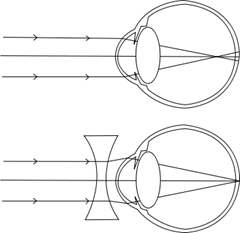
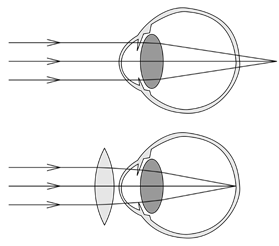
When a person is unable to see distant objects clearly but can see nearby objects clearly, then he is considered to be myopic. If a person is able to see distant objects clearly but cannot see nearby object clearly, then he is considered to be hypermetropic.


The short- sightedness or myopia is corrected by using a concave lens, which diverges and shifts the image to the retina as follows:


Long-sightedness or hypermetropia is corrected by using a convex lens, which converges and shifts the image to the retina as follows:


OR
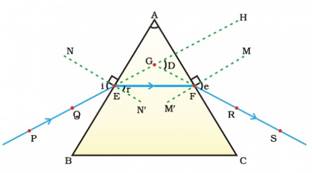


The light ray PQ enters the triangular glass prism ABC at point E at an angle of incidence i. Since the medium of the prism is denser than the surrounding, the light ray is refracted at an angle of refraction r towards the normal NN’. The light ray RS leaves the prism at F with an angle of emergence e. Since the medium of the surrounding is rarer than the prism medium, the light ray is refracted away from the normal MM’.


It may be observed that the light ray entering the prism is not parallel to the light ray emerging from the prism. There is some deviation in its path. The angle through which the light ray deviates from its original path is called the angle of deviation D. The angle of deviation can be illustrated by extending the ray of incidence PQ up to H and the emerging ray RS up to G. The angle between these two lines gives the angle of deviation D.


If a beam of white light is passed through a glass prism, it is separated into its constituent colors. This phenomenon is known as dispersion.


More from this chapter

All 805 →
31

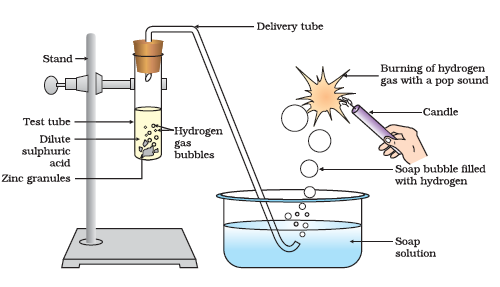
In the following schematic diagram for the preparation of hydrogen gas as shown in Figure, what would happen if following changes are made?


(a) In place of Zn granules , same amount of zinc dust is taken in the test tube


(b) Instead of dilute sulphuric acid, dilute hydrochloric acid is taken


(c) In place of Zn, Cu turnings are taken


(d) Sodium hydroxide is taken in place of sulphuric acid and tube is heated


OR


A metal carbonate X on reacting with an acid gives a gas which when passed through a solution Y gives the carbonate back. On the other hand, a gas G that is obtained at anode during electrolysis of brine is passed on dry Y, it gives a compound Z, used for disinfecting drinking water. Identity X, Y, G and Z. Also, write the chemical reactions involved.

32

When ethanoic acid reacts with sodium hydrogencarbonate, a salt X is formed and a gas Y is evolved.

(a) Identify X and Y. Write chemical equation of reaction involved.


(b) Describe an activity and draw the diagram of the apparatus to prove that the evolved gas is the one which you have named.


OR


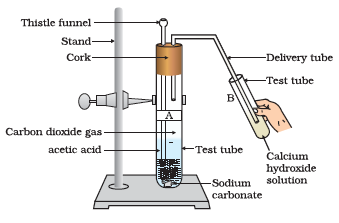
Look at Figure and answer the following questions.


(a) What change would you observe in tube B containing calcium hydroxide solution


(b) Write the reaction involved in test tubes A and B respectively


(c) If ethanol is given instead of acetic acid, would you expect the same change?


(d) How can a solution of lime water be prepared in the laboratory?

34

How can solar energy be harnessed? What are the limitations in using solar energy? How are these limitations overcome?

OR


What is biomass? Explain the principle and working of a biogas plant using a labelled schematic diagram

35

Explain with the help of a labelled diagram the distribution of a magnetic field due to a current through a circular loop. Why is it that if a current carrying loop has n turns the field produced at any point is n times as large as that produced by a single turn?

OR


Explain the phenomenon of electromagnetic induction? Describe an appropriate experiment to show that a current is set up in a closed loop when an external magnetic field passing through the loop increases or decreases.