Q16 of 805 Page 1

With the help of a diagram, explain the principle of a device which changes a low voltage into a high voltage but does not violate the law of conservation of energy. Give any one reason why the device may not be 100% efficient.

The transformer is a device used to convert low voltage to high voltage and vice versa without loss in energy.


A transformer is a static device which transforms electric energy from one circuit to another without any direct electrical connection and with the help of mutual induction between two coils.


Working principle: it works on the principle of mutual induction of two coils or Faraday Law’s Of Electromagnetic induction. When the current in the primary coil is changed the flux linked to the secondary coil also changes. Hence an EMF is induced in the secondary coil due to Faraday law’s of electromagnetic induction.
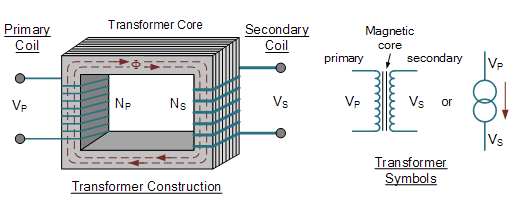


A transformer is not 100% efficient as all the electrical energy in the primary coil is not transferred to the secondary coil. Some of it is lost due to resistance in the winding and also due to magnetic effects such as core loss or iron loss.


More from this chapter

All 805 →
14

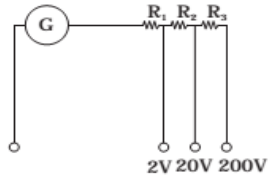
A multirange voltmeter can be constructed by using a galvanometer circuit as shown in the figure. We want to construct a voltmeter that can measure 2V, 20V and 200V using a galvanometer of resistance 10Ω and that produces maximum deflection for a current of 1 mA. Find the value of R1, R2 and R3 that have to be used.

15

The figure shows a metal rod PQ of length l, resting on the smooth horizontal rails AB positioned between the poles of a permanent magnet. The rails, rod and the magnetic field B are in three mutually perpendicular directions. A galvanometer G connects the rails through a key ‘k’. Assume the magnetic field to be uniform. Given the resistance of the closed loop containing the rod is R.

(i) Suppose K is open and the rod is moved with a speed v in the direction shown. Find the polarity and the magnitude of induced emf.


(ii) With K open and the rod moving uniformly, there is no net force on the electrons in the rod PQ even though they do experience a magnetic force due to the motion of the rod. Explain.


(iii) What is the induced emf in the moving rod if the magnetic field is parallel to the rails instead of being perpendicular?


17

In a double slit experiment, the distance between the slits is 3 mm and the slits are 2 m away from the screen. Two interference patterns can be seen on the screen one due to light with wavelength 480 nm, and the other due to light with wavelength 600 nm. What is the separation on the screen between the fifth order bright fringes of the two interference patterns?

18

What do you understand by the statement ‘Light from the sun is unpolarised’. Explain how does sunlight gets polarized by the process of scattering?