Q13 of 805 Page 1

The following table gives the length of three copper wires, their diameters, and the applied potential difference across their ends. Arrange the wires in increasing order according to the following:

(a) The magnitude of the electric field within them,


(b) The drift speed of electrons through them, and


(c) The current density within them.


a) We know that electric field of a line charge E =


where λ = charge per unit length = q/L


We know that potential difference V = W/q


Therefore


Therefore E2 < E3 < E1.


b) Drift velocity


Drift velocity is inversely proportional to the area


Area (A) = πd2/4


Current


We know that potential difference V = W/q


n = q/e


Therefore


Therefore Vd2< Vd3 < Vd1


c) Current density J = I/A


I =nAeVd


J = σE


J = n e Vd


Therefore J2< J3< J1


More from this chapter

All 805 →
11

(a) How many electrons must be added to one plate and removed from the other so as to store 25.0 J of energy in a 5.0 nF parallel plate capacitor?

(b) How would you modify this capacitor so that it can store 50.0 J of energy without changing the charge on its plates?

12

A point charge + Q is placed at the centre O of an uncharged hollow spherical conductor of inner radius ‘a’ and outer radius ‘b’. Find the following:

(a) The magnitude and sign of the charge induced on the inner and outer surface of the conducting shell.


(b) The magnitude of electric field vector at a distance (i) r = , and (ii) r = 2b, from the centre of the shell.


14

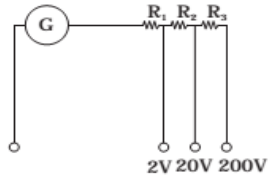
A multirange voltmeter can be constructed by using a galvanometer circuit as shown in the figure. We want to construct a voltmeter that can measure 2V, 20V and 200V using a galvanometer of resistance 10Ω and that produces maximum deflection for a current of 1 mA. Find the value of R1, R2 and R3 that have to be used.

15

The figure shows a metal rod PQ of length l, resting on the smooth horizontal rails AB positioned between the poles of a permanent magnet. The rails, rod and the magnetic field B are in three mutually perpendicular directions. A galvanometer G connects the rails through a key ‘k’. Assume the magnetic field to be uniform. Given the resistance of the closed loop containing the rod is R.

(i) Suppose K is open and the rod is moved with a speed v in the direction shown. Find the polarity and the magnitude of induced emf.


(ii) With K open and the rod moving uniformly, there is no net force on the electrons in the rod PQ even though they do experience a magnetic force due to the motion of the rod. Explain.


(iii) What is the induced emf in the moving rod if the magnetic field is parallel to the rails instead of being perpendicular?